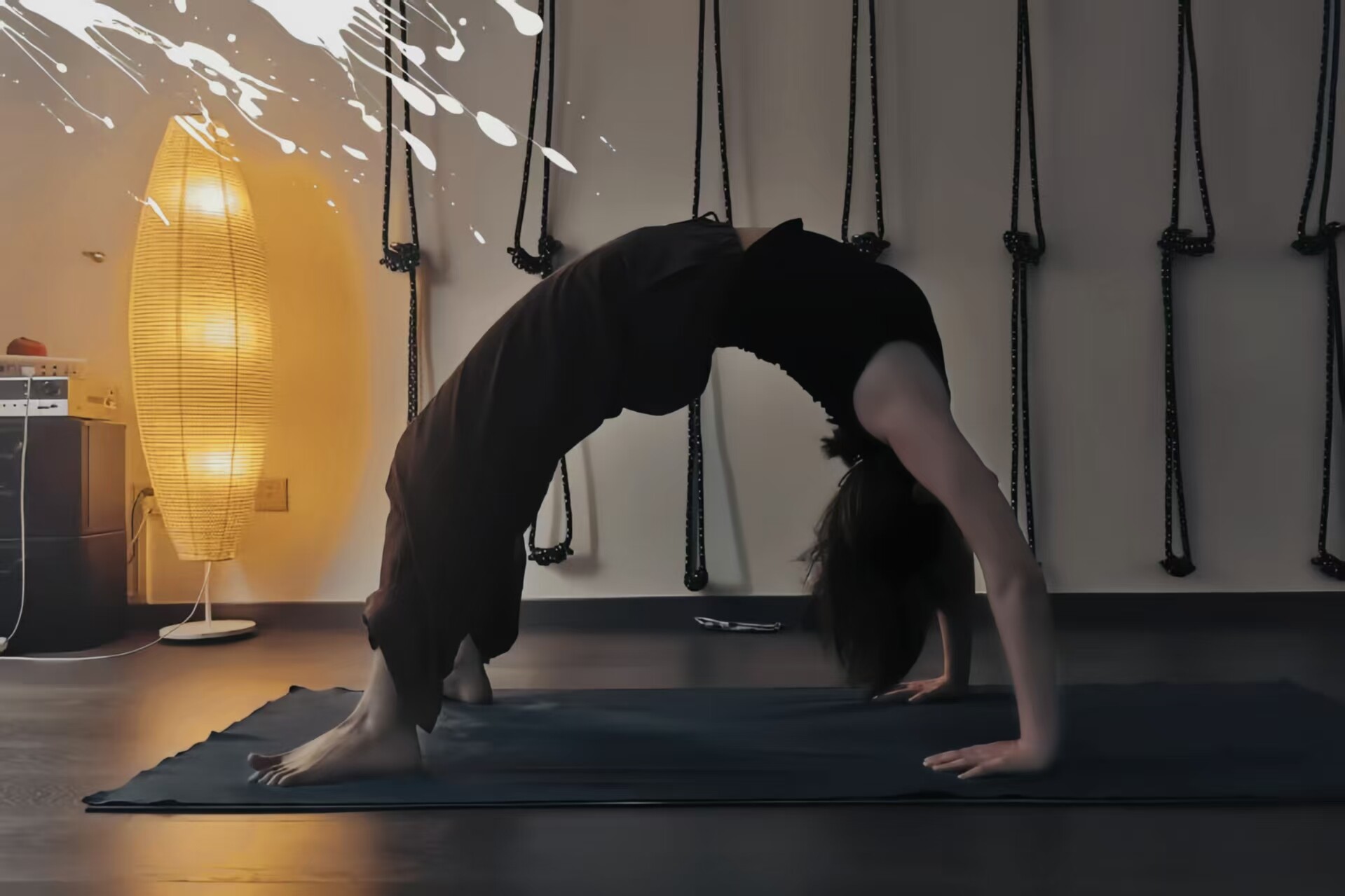
Wheel Pose: Discover a more flexible you.
Preface
Backbends are not the goal.
The true essence is discovering a more flexible self through wheeling.
Don't fear a stiff body; fear a closed mind.
Wheels help you break through your limits. Let go of attachments to embrace infinite possibilities.
The significance of wheels
Awakening of the Body
Wheel Pose (Urdhva Dhanurasana), also known as Upward Bow Pose, is one of the most challenging backbends in yoga.
It's more than just a pose demonstration; it's a deep practice for integrating mind and body.
Breakthrough of the Mind
As we move into this backbend, we face not only physical limits but also inner fear and resistance.
Every attempt at wheeling is a conversation with yourself.
Benefits of wheels
Physical
- Enhance spinal flexibilitySegmental motion to improve spinal health
- Open the chest: Expand lung capacity and improve breathing quality
- Strengthen arms and legs: Build full-body strength and stability
- Stimulate glands: Activates the thyroid and adrenal glands; regulates endocrine function
Psychological
- Overcome FearLearn to trust your body.
- Build Courage: Never back down from challenges
- Relieve stress: Open Emotion Storage
- Boost Your Confidence: Break through self-imposed limits
Practice Prep
Basic Strength
The following prerequisites must be established before attempting the full wheel:
- arm strength: Can stably support body weight
- Core StrengthMaintain body stability
- Back StrengthProtect your spine and avoid injury.
- Leg strength: Provide upward thrust
Flexibility Warm-up
- Open the shoulder joint: Arms can fully extend
- Thoracic Mobility: The upper back can bend backward.
- Hip Flexor StretchOpen at the front to avoid waist compression
- Front thigh stretchQuadriceps flexibility
Warm-up sequence
Step 1: Cat-Cow Pose (5-8 breaths)
Move your spine, awaken every vertebra.
Step 2: Cobra Pose (3 reps, 5 breaths per rep)
Gentle backbend to activate back muscles.
Step 3: Bridge Pose (3 times, 5 breaths per set)
Open your chest to build a foundation for backbends.
Step 4: Camel Pose (2–3 reps)
Deeply open the chest and shoulder joints.
Step 5: Dolphin Pose (5-8 breaths)
Build arm and shoulder strength.
Wheel-based Practice Method
Staged Version 1: Wall-Mounted Wheeled
Ideal for: Beginners, those with insufficient strength
Practice Methods:
- Lie on your back, bend your knees, and place your feet flat on the floor.
- Place both hands on the sides of your ears with fingertips pointing toward your shoulders.
- Inhale, push off the ground with both hands and feet simultaneously.
- Lift your hips off the ground and gently touch the wall with the top of your head.
- Keep 3-5 breathing, lower slowly
Key Points:
- Focus on opening the chest, not compressing the waist.
- Keep elbows from flaring out; keep them shoulder-width apart.
- Lengthen your spine
Reduced Version 2: Semi-Round
Ideal for: Has some foundation but cannot fully straighten the arm
Practice Methods:
- Lie on your back, bend your knees, and place your feet flat on the floor.
- Place both hands on either side of your ears.
- Push up your body, keep arms bent
- Lift your chest upward
- Keep 3-5 breathing
Key Points:
- Do not force your arms straight.
- Focus on opening the chest.
- Breathe evenly
Full Wheel
Ideal for: Possesses sufficient strength and flexibility
Practice Methods:
- Lie on your back, bend your knees, and place your feet flat on the floor hip-width apart.
- Place both hands on the sides of your ears with fingertips pointing toward your shoulders.
- Inhale, push off the ground with both hands and feet simultaneously.
- Exhale, extend your arms, and fully open your chest.
- Keep your head relaxed and avoid compressing the cervical spine.
- Keep 5-8 breathing
- Exhale and slowly curl your spine down.
Key Points:
- As you push up, imagine your chest extending toward the ceiling.
- Keep elbows from flaring out; keep them parallel.
- Keep thighs perpendicular to the floor; do not let knees flare outward.
- Feel the opening of the entire front side of your body.
Common Errors and Corrections
Error 1: Elbow abduction
Issue: Open elbows to the sides, tuck shoulders in.
Correct:
- Consciously tuck your elbows inward.
- Use a yoga block between your upper arms for support during practice.
- Increase awareness of shoulder external rotation
Error 2: Waist pinching
Issue: Backward bending concentrates on the lower back, causing pain.
Correct:
- Focus on thoracic spine extension
- Strengthen your core to protect your lower back
- Start with chest-opening poses to improve thoracic mobility.
Error 3: Breath-holding
IssueHolding breath due to nervousness or exertion
Correct:
- Breathe deeply and evenly.
- If you can't breathe, the intensity is too high. Reduce the level.
- Guide your breath, not control it.
Exit Pose
ImportantExiting the wheel is just as important as entering it.
Steps:
- Exhale and slowly bend your elbows.
- Bring the head down to land first (if already airborne).
- Curl the spine and lower it segment by segment.
- Hug your knees to your chest and gently relax your lower back.
- Baby Rest 5-8 Breathing
Contraindications and Precautions
Contraindicated Population
- For individuals with wrist, shoulder, or back injuries
- Pregnant women
- Patients with severe hypertension or heart disease
- Acute Phase of Herniated Disc
- Recent abdominal surgery patients
Practice Tips
- Fasted workoutWait at least 3-4 hours after eating.
- Warm up thoroughly: Do not enter the wheel directly
- step by step: Respect your body's natural rhythm
- Listen to your body: Pain is a signal to stop
Spiritual Insights
Let go of attachments
The Wheel Pose teaches us not just physical backbends, but also the softness of the mind.
Don't fear a stiff body; fear a closed mind.
Let go of the need to "get it right," and you'll naturally flow into your asanas.
Embrace the unknown
The moment you fall backward, trust is all that's needed.
Trust your body.
Building trust through practice
Trust in Life's support.
Break Limits
Every round of wheel practice breaks through self-imposed limits.
Those who think it can't be done,
With persistence and patience,
It will become possible.
Supplementary Practice Suggestions
Daily Practice Sequence
Monday: Power Established
- Bridge 3 times
- Dolphin kicks: 3
- Plank 3 times
Wednesday: Flexibility
- Camel Pose 3 times
- Fish 2 times
- Cow Face Arms
FridayIntegration Practice
- Complete Warm-up Sequence
- Omni-wheeled or fully omnidirectional
- Child's Pose
Assistant Tools
- Yoga Block: Place under hand to reduce difficulty
- Yoga Strap: Straps on the upper arm to prevent abduction
- wall: provides security and support
- Pillow: Positioned below the thoracic spine to assist with thoracotomy.
Conclusion
Backbends are not the goal.
The true essence is discovering a more flexible self through wheeling.
During this backward opening process,
We learn to trust,
Learn to let go.
Embrace infinite possibilities.
May your practice on wheels be...
Find your body's strength,
Find the tenderness of your soul.
Meet a better version of yourself.
Namaste